The Wrongs of the Right: Language, Race, and the Republican Party in the Age of Obama by Matthew W. Hughey & Gregory S. Parks
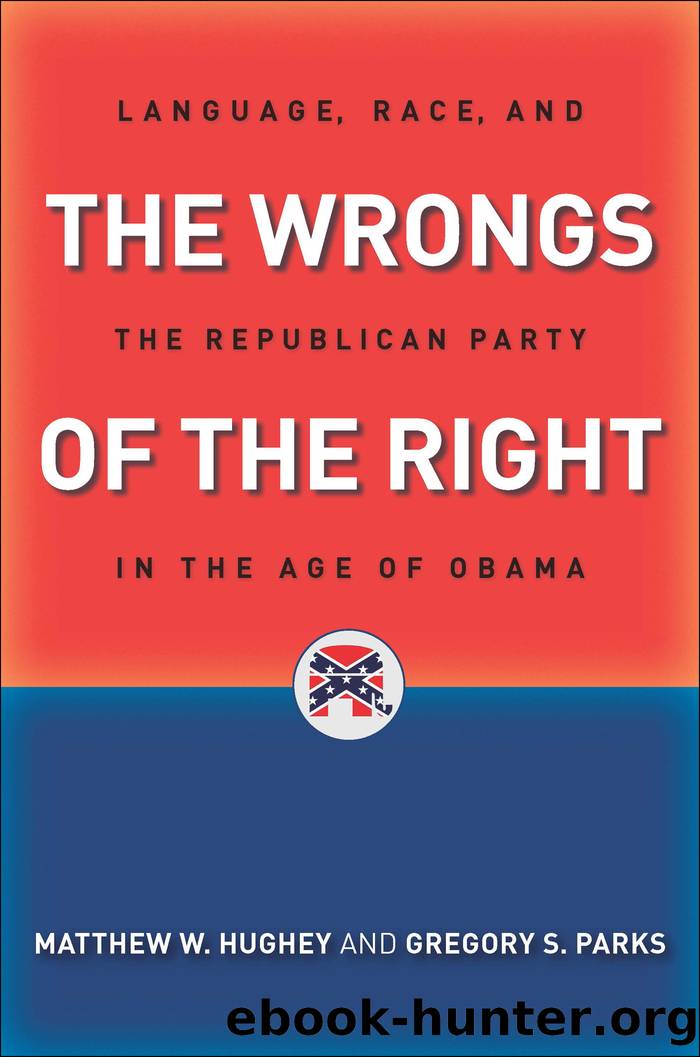
Author:Matthew W. Hughey & Gregory S. Parks [Hughey, Matthew W. & Parks, Gregory S.]
Language: eng
Format: epub
Tags: Ethnic Studies, American, National, Social Science, African American & Black Studies, Political Science, American Government, Sociology, Politics, General
ISBN: 9781479826797
Google: RQLMCgAAQBAJ
Goodreads: 27558371
Publisher: New York University Press
Published: 2014-05-30T00:00:00+00:00
Political Ideology and Unconscious Race Bias
The theory of âprincipled conservativismâ suggests that white opposition to policies like affirmative action is largely derived from race-neutral political ideologies and value systems (e.g., self-reliance and a desire for small government), rather than racist or racialized ideologies or opinion.43 The principled conservativism perspective emerged from the dominant discourse of perceived American post-racialism44âa widely shared perspective and narrative that racism and dominance-oriented motives no longer undergird white attitudes toward race-targeted policies.45 Proponents of principled conservativism contend that political valuesânot racismâprovide the dominant framework for understanding race-based policies.46 Accordingly, those who subscribe to the principled conservative model believe that once the effects of ideology (i.e., conservativism) and race-neutral political values are accounted for, racism and dominance-oriented attitudes should hold no predictive power in whitesâ opposition to race-based policies such as affirmative action.47 This theory has found some support in studies that indicate (1) that antiblack affect is weakly related to conservatism and opposition to race-targeted policies48 and (2) that conservatives are not more likely to hold a double standard with regard to blacks in the allocation of aid vis-Ã -vis disadvantaged members of other groups.49 These are points we aim to upend.
To be clear, the principled-conservatism model does not suggest that opposition to race-targeted policies is free from racism, but rather that the opposition-racism relationship is more likely to be found among the poorly educated.50 Theoretically, then, since some individuals supposedly lack the intellectual sophistication to understand both the explicitly egalitarian ethos of American political culture and abstract ideas, their attitudes toward race-based policies and politics are driven by racial animus.51 In contrast, well-educated, principled conservatives will base their policy positions on abstract principles and articulate them in light of express racial egalitarian norms, thus attenuating the influence of racism and in-group preference.52
However, scholars have long argued that right-wing political conservatism hinges on the embrace of social inequality and resistance to change.53 Other studies of large datasets (ranging from n = 28,816 to 732,881) found that at the explicit level, conservatives, when compared to liberals, generally favor higher-status groups to lower-status groups (e.g., others to Arabs-Muslims, others to Jews, straight people to gays, whites to blacks, light-skinned to dark-skinned people, and white to black children).54 We believe that such research destabilizes the contention that education, to the exclusion of political orientation, is the key variable for determining explicit racial bias. But what about implicit racial bias? The same pattern occurs. For example, at the implicit level, research suggests that conservatives, when compared to liberals, favor higher-status groups to lower-status groups (e.g., thin people to overweight people, others to Arabs-Muslims, others to Jews, others to the disabled, straight people to gays, whites to blacks, light-skinned to dark-skinned people, and white to black children).55 The notion that liberals hold more egalitarian implicit attitudes than conservatives has found support in an array of studies.56 Importantly, for whites and blacks both, the more conservative they are, the more they prefer whites over blacks.57
This robust correlation certainly poses a chicken-or-egg problem: Does
Download
This site does not store any files on its server. We only index and link to content provided by other sites. Please contact the content providers to delete copyright contents if any and email us, we'll remove relevant links or contents immediately.
| Anthropology | Archaeology |
| Philosophy | Politics & Government |
| Social Sciences | Sociology |
| Women's Studies |
Cecilia; Or, Memoirs of an Heiress — Volume 1 by Fanny Burney(32559)
The Great Music City by Andrea Baker(32020)
Cecilia; Or, Memoirs of an Heiress — Volume 2 by Fanny Burney(31957)
Cecilia; Or, Memoirs of an Heiress — Volume 3 by Fanny Burney(31943)
We're Going to Need More Wine by Gabrielle Union(19049)
All the Missing Girls by Megan Miranda(16033)
Pimp by Iceberg Slim(14513)
For the Love of Europe by Rick Steves(14138)
Bombshells: Glamour Girls of a Lifetime by Sullivan Steve(14077)
Talking to Strangers by Malcolm Gladwell(13374)
Norse Mythology by Gaiman Neil(13371)
Fifty Shades Freed by E L James(13244)
Mindhunter: Inside the FBI's Elite Serial Crime Unit by John E. Douglas & Mark Olshaker(9345)
Crazy Rich Asians by Kevin Kwan(9293)
The Lost Art of Listening by Michael P. Nichols(7507)
Enlightenment Now: The Case for Reason, Science, Humanism, and Progress by Steven Pinker(7315)
The Four Agreements by Don Miguel Ruiz(6766)
Bad Blood by John Carreyrou(6623)
Weapons of Math Destruction by Cathy O'Neil(6282)
